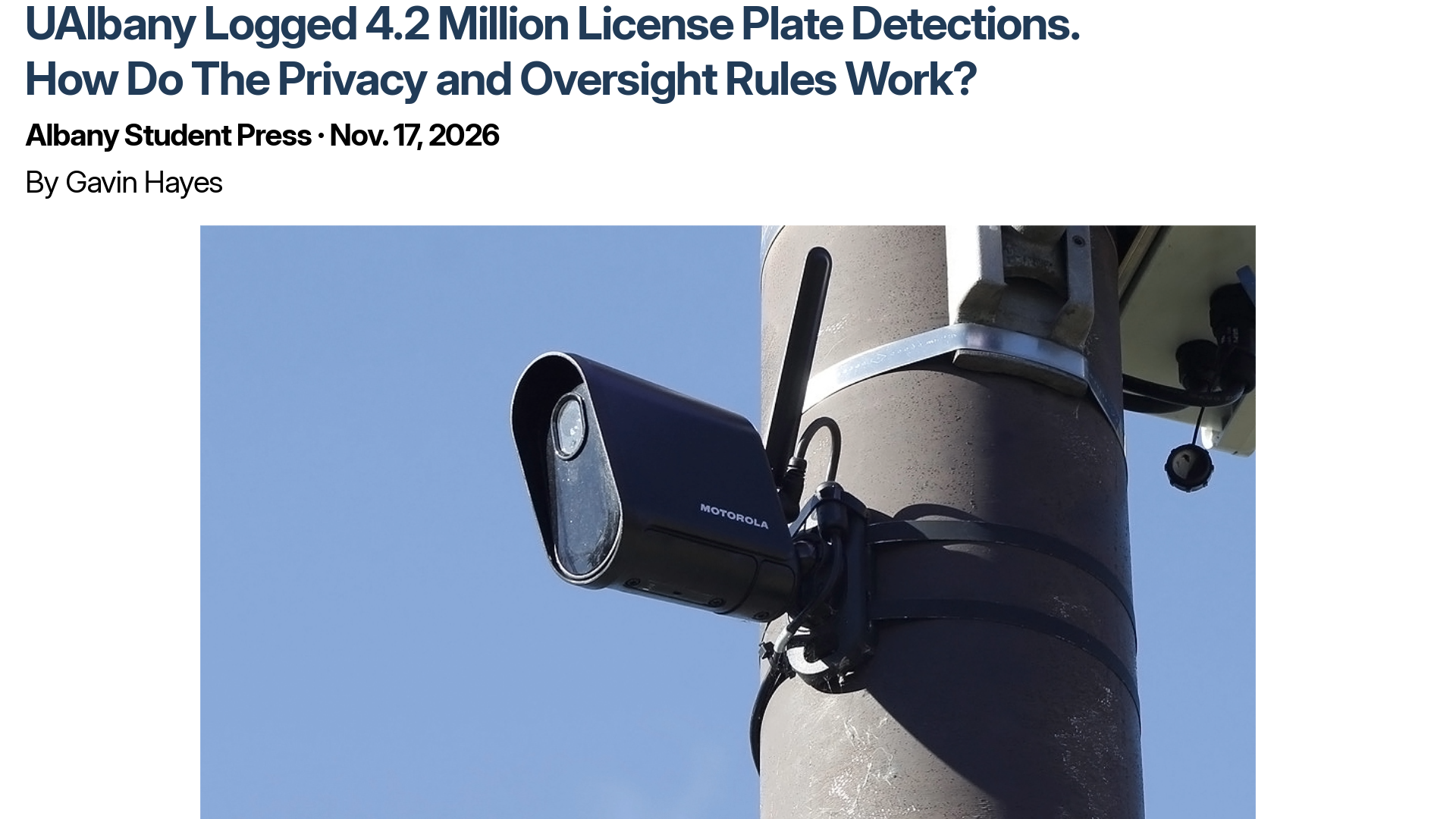
What do UAlbany’s police chief, the chair of its Independent Review Committee, the public information director for New York’s Division of Criminal Justice Services, the University at Buffalo’s president, a UB professor who helped organize a campus petition, and Motorola Solutions all have in common?
License plate reader technology.
The University at Albany Police Department (UPD) recorded more than 4.2 million license plate detections through Aug. 31, 2026, according to records obtained through a Freedom of Information Law request.
University Police Chief Paul Burlingame confirmed in a Nov. 10 email that all 4,206,206 detections came from UPD’s license plate reader (LPR) system. The total includes repeat captures of the same vehicle.
The first LPR camera began capturing vehicle images on Aug. 12, 2025, and “it took quite a while before the full system was functional,” Burlingame said.
UPD’s system has 12 LPR cameras, Burlingame said. A device-count report dated Sept. 25, 2026, listed 10 online, one offline and one with a warning.
In response to a question about what UPD’s monthly audits had found, Burlingame wrote, “We have not found any records of unauthorized searches but have identified a few policy violations relating to how officers were documenting their vehicle searches.”
The system collects license plate numbers, vehicle images and information about vehicle make, model and color, according to the university’s police webpage. Officers need another source of information to link a plate number to a person or registration address, Burlingame said.
Parking & Mass Transit Services operates a separate license plate reader system. UPD says its readers are not connected to outside LPR systems such as Flock, Axon or Genetec.
“The system was purchased and installed for $117,040 and was fully funded by a Justice Assistance Grant. This also covered the first couple of years of maintenance and licensing costs. To date, the university has not incurred any expense for the system,” Burlingame said.
In its response to the records request, the university identified a contract and purchase orders with Motorola Solutions, along with a data-sharing agreement with the Capital Region Crime Analysis Center (CRCAC).
Motorola Solutions did not respond to a request for comment before publication.
On Nov. 16, UAlbany released the Aug. 18 agreement formalizing UPD’s participation in the Capital Region Crime Analysis Center. The agreement adopts the center’s existing memorandum, under which the agency that originated the data retains ownership and responsibility for its use, sharing, sealing and purging. The agreement leaves procedures specific to license plate reader data unspecified.
Andrea Lurie Miller, the university’s records management and access officer, said Nov. 23 remains the anticipated release date for the Motorola Solutions contract and purchase orders.
UAlbany's LPR Policy and Data-Sharing Logistics
Under UPD’s LPR policy, data releases require authorization from the chief or a designee.
Sharing data with outside law enforcement entities requires a memorandum of understanding, and the policy identifies CRCAC as having one. The receiving agency must use and store the data, in line with UPD’s policy.
Burlingame said UPD had a data-sharing agreement with CRCAC for several years and had formally agreed to share LPR data if needed. The center would have to ask UPD to process a request on its behalf, he said.
Aaron Cagwin of the state Division of Criminal Justice Services acknowledged an existing data-sharing agreement in a Nov. 10 email, but also said that CRCAC “does not currently receive license plate reader data from the University at Albany Police Department, nor does it have direct access to that information.”
UPD’s license plate reader policy authorizes the technology for investigations, locating missing or vulnerable people and assessing public safety threats. The policy became effective Sept. 4, 2025, and was revised Aug. 6, 2026.
Burlingame said UPD’s LPR system helped identify suspects in an armed robbery and a sexual assault investigation, as well as vehicles involved in campus hit-and-run crashes. The system also alerted officers to someone previously involved in a campus dating violence incident. He said many cases involving LPR data were still moving through the judicial system, limiting the details he could provide.
Researcher's Opinion on LPR Tech
Robert Worden, a professor in UAlbany’s School of Criminal Justice and chair of its Independent Review Committee (IRC), offered his assessment in his personal capacity as a policing researcher.
“I am aware of very few studies of the larger-scale deployment of (especially fixed) LPRs, but the research suggests that LPRs may improve the rate at which police investigations are successful in identifying perpetrators, especially with respect to some types of offenses (auto theft, robbery),” Worden said.
Worden cautioned against evaluating the cameras’ effectiveness by how often LPR systems are used in police investigations.
“That LPR technology was used in a fraction of criminal investigations does not imply that it contributed at the margin to the outcomes of those cases,” he said.
How LPR Tech is Used in Investigations
According to the policy, a “hotlist” contains license plate numbers associated with stolen vehicles, wanted people, missing-person alerts and other investigative targets. The list also includes stolen license plates and suspended or revoked registrations.
When the system generates a hotlist alert, officers must verify that the captured image matches the license plate and state of registration before taking action. If a match is confirmed, the officer is required to notify the shift supervisor, who determines the appropriate patrol response.
According to the policy, prohibited uses of the technology include personal or unofficial use, investigations based solely on religious, political or social views during lawful activities, and inquiries that violate constitutional rights.
“Each inquiry into LPR data must contain an appropriate investigative case number along with the reason for the inquiry,” the policy states.
The policy requires Deputy Chief of Investigations Paul Hogan to conduct and record monthly audits of who uses the LPR system and how they use it. If an audit flags possible misuse or a policy violation, the matter goes to Burlingame, who must ensure it is investigated.
Burlingame said UPD gave officers additional training that appeared to address common documentation problems.
“Our last audit did not reveal any issues,” he said.
Worden said the IRC reviews completed UPD investigations into complaints against police personnel. It also reviews how UPD handled incidents referred by the police chief and prepares annual reports.
“The IRC has not had occasion to examine UPD’s use of LPRs, and it has no role in reviewing UPD’s use of surveillance technologies more generally except insofar as the issue arises in the context of the functions described above,” Worden said.
“Speaking not for the IRC but only for myself as a social scientist who conducts research on policing, I would say that the most important form of oversight of LPR technology consists of administrative audits of access to LPR data by police personnel to ensure that it is effectively restricted to authorized purposes,” he said.
Captured vehicle images are automatically deleted after 30 days, Burlingame said. System statistics, audit records, vehicle search records and user access logs remain for at least a year. Documents generated for audits or preserved as evidence in criminal investigations follow state retention rules, he said.
Recent Debates on LPR Cameras Occur at Other SUNY Campus
The University at Buffalo announced Nov. 5 that it had indefinitely paused plans for an LPR pilot.
“After careful deliberation over the past several weeks, I have decided that additional conversation and engagement with the university community is needed before determining whether to proceed with the pilot program,” President Caroline Attardo Genco said in the announcement.
The university said its University Police Advisory Committee, which includes faculty, staff and students, would gather additional community feedback.
Kari Winter, a University at Buffalo professor of American studies and member of UB’s Police Advisory Committee, helped organize a petition in opposition to the university’s proposed LPR pilot. Winter responded to interview questions in a Nov. 9 email.
“As soon as the UB police, in a September meeting, described their plans to install Flock cameras across UB's three campuses on a trial basis, I voiced concerns. After the meeting, other committee members shared their sense of alarm with me. I then partnered with multidisciplinary colleagues to organize a community petition against the installation of LPRs,” Winter said. UB’s Nov. 5 FAQ described a 60-day trial of 20 Flock Safety cameras at entrances and exits on the university’s North and South campuses. The petition had 945 signatures as of Nov. 9, Winter said.
Winter said United University Professions, the union representing SUNY faculty and professional staff, also raised concerns about LPRs. She said UB’s graduate and undergraduate student associations were organizing their own surveys and petitions opposing the technology.
On Oct. 20, 2026, the UB Faculty Senate voted 54–4 to support the community petition opposing the installation of license plate readers at UB, according to Winter.
“Students, staff, faculty and alumni need to speak up and make sure that their voices are heard. University administrations often fail to request input from the community, and they often ignore input even when they request it. Speak up and organize,” Winter said.
Winter said she does not think safeguards or oversight can adequately address the risk of misuse.
“Institutions that install LPR technology endorse the idea, unsubstantiated by research, that LPRs will reduce crime and help track down criminals. What we know for sure based on hundreds of cases across the country is that LPRs have been used, in many cases by police officers themselves, to commit crimes. In other words, LPRs empower criminality,” Winter said.
Winter did not identify specific cases in her Nov. 9 email.
Winter encouraged other SUNY communities to organize in opposition to LPR technology.
“I have been teaching since 1984, and I have never witnessed a university community as united in opposition to an idea as UB is united in opposition to Flock cameras,” Winter said.